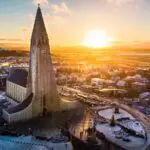
Stand outside Hallgrímskirkja church and you’ll quickly there is plenty to occupy your camera. The church rises above you, Leif Erikson surveys the square, and Skólavörðustígur slopes downhill toward its familiar rainbow.
Yet a short walk around the neighbouring museum brings you somewhere altogether different, a rather beautiful garden populated by figures caught in moments of grief, tenderness and extraordinary physical effort.
This is the Anna Johnson Sculpture Garden, one of the most rewarding free places to visit in Reykjavík. You can stop for ten minutes between sightseeing appointments, although the sculptures do deserve longer.
Like much of the great art found in Iceland, the stories told here have a habit of making you pause and reflect on this land’s long history and cultural depth.
Where to find the sculpture garden

The garden sits behind the Einar Jónsson Museum at Hallgrímstorg 3, immediately beside the iconic Hallgrímskirkja church on Skólavörðuholt hill. If you are already visiting this famed national landmark, you are practically there.
Walk around the museum to reach the garden rather than assuming you need to enter through the exhibition rooms; you’ll find the black iron gate is open during the days, inviting passersby to satiate their curiosity.
And they are rewarded for doing so. Inside are 26 bronze casts of Einar’s works, arranged among trees, bristling hedgerows, and neatly arranged flower beds.
The setting allows you to approach a sculpture, circle it, and discover how much its appearance changes when you take a few steps to the side. A figure that seems dominant from one angle can look surprisingly vulnerable from another. Such is the genius of Einar’s work.
Now is a good point to mention that admission to the garden is free, and it is open year-round, day and night. The indoor museum is a separate, ticketed visit, with its own opening hours. You do not need a museum ticket to enjoy the garden, but of course, both experiences complement the other.
Who was Einar Jónsson?

Born at Galtafell farm in southern Iceland in 1874, Einar Jónsson became a pioneering figure in Icelandic sculpture. He moved to Copenhagen in 1893 and studied at the Royal Danish Academy of Fine Arts between 1896 and 1899. Developing a career abroad was a necessity at the time given how opportunities at home were limited.
His breakthrough came in 1901, when his prized sculpture Outlaws appeared at Copenhagen’s Charlottenborg spring exhibition.

Looking at all his pieces, it’s clear how Icelandic folklore informed his early work, and later, his time in Rome would strengthen his determination to follow his own imagination. He became increasingly interested in symbolism, using recognizable figures and stories to express ideas beyond their literal appearance.
In 1909, Einar offered his artworks to the Icelandic state. Parliament agreed in 1914 to fund their transport home and care for them. A museum followed, opening in 1923. He and his wife Anna made their home in the building, bringing everyday life and artistic work under the same roof.
Einar died in 1954. His legacy extends well beyond this garden, including Reykjavík’s statue of independence campaigner Jón Sigurðsson at Austurvöllur.
A museum designed by the artist

Before visiting the garden and appreciating all that’s inside, we also suggest you take a look at the building that watches over it. Known as the rather difficult-to-pronounce Hnitbjörg, it has a heavy, sculptural presence, with angular forms that make it feel closely related to the work it contains.
Einar designed the museum with architect Einar Erlendsson. It combined exhibition space, a studio and accommodation, making the building itself part of the artist’s creative project. When the museum opened on June 24, 1923, it became Iceland’s first public art museum on its own premises.
Its prominent hilltop position was particularly striking when the surrounding neighborhood was much less developed. Imagine encountering this building above the low roofs of early twentieth-century Reykjavík.
There is an architectural distinction worth making here. Guðjón Samúelsson designed Hallgrímskirkja next door; the museum was Einar Jónsson’s vision, developed with Erlendsson.
Two neighboring buildings, two very different approaches to making an impression.
How to look at Einar Jónsson’s sculptures

For those on the fence, know that you do not need an art-history qualification to enjoy the garden. Simply an open mind.
Start with the bodies. Which of Einar’s subjects are carrying a burden? Who seems trapped, protected or on the verge of escape? Notice their hands, the direction of a face and the space between two figures.
As we’ve mentioned, Einar drew on folklore, religious ideas and mysticism, often exploring the relationship between physical existence and spiritual life. His figures can suggest an inner struggle as strongly as an outward action. A heavy mass might evoke emotional weight; an upward movement might suggest release.
Those are ways into the work, rather than a compulsory answer sheet. Let your first impression develop before reading a title. Sometimes a sculpture becomes more interesting when you cannot explain it immediately.
Visit with Your Friend in Reykjavík

Often, the garden features on Your Friend in Reykjavík’s Reykjavík CatWalk, a guided stroll through downtown streets that combines local history, feline folklore and a search for some of the city’s resident cats.
The tour finishes at the sculpture garden near Hallgrímskirkja, giving visitors a chance to encounter Einar’s work as part of a wider introduction to Reykjavík.
A private version of the CatWalk is available too, of course. It is an appealing option if your interests run from cultural history to whichever cat has decided to occupy the pavement that morning.
You can explore the garden independently, of course. Joining a guide adds conversation and context, connecting this quiet corner with the stories and everyday life of the surrounding city. (Note: the cats retain control of their own attendance.)
Other Reykjavík museums worth exploring

If the garden leaves you wanting more sculpture, make time for Ásmundarsafn in Laugardalur. Dedicated to Ásmundur Sveinsson, it occupies his former home and studio and has an outdoor collection of his work.
Visiting both offers an enjoyable way to compare two major Icelandic sculptors and the buildings they created around their art.
For a change of pace, head toward the harbor to Hafnarhús, another Reykjavík Art Museum venue. Its exhibitions include work by Erró alongside contemporary art, taking you into a very different visual world from Einar’s bronzes.
The National Museum of Iceland is a good choice for broader historical context. Its permanent exhibition, Making of a Nation, follows Icelandic history through objects that help explain how people lived and how their society changed.
Do not overlook the indoor Einar Jónsson Museum itself. Alongside the artworks, the preserved apartment of Einar and Anna brings a more domestic perspective to the visit. After studying so many monumental figures outside, seeing the rooms where their creator lived provides a welcome change of scale.
Leave a little time to linger
Allow around half an hour for an unhurried look around the garden, or longer if you enjoy photography and reading about individual works. Dress for the weather, and take care on paths in icy conditions.
Above all, resist treating it as a quick addition to your church photograph. Choose a sculpture, walk around it, and give it a second look. There is a surprising amount happening in this small patch of Reykjavík.